
Key Takeaways
- Understanding the primary sources of road noise is essential for effective reduction strategies.
- Innovations in materials and technology have significantly improved noise reduction in vehicles.
- Implementing both passive and active noise control methods can enhance the driving experience.
Table of Contents
- Understanding Road Noise Sources
- Innovative Materials for Noise Reduction
- Active Noise Control Technologies
- Impact of Speed on Road Noise
- Future Trends in Noise Reduction
Road noise is a significant concern for motorists, affecting not only driving comfort but also health and well-being. Modern engineering and scientific advancements have enabled the addressing of these issues from multiple directions, resulting in noticeably quieter cabins and more pleasant driving environments. Both carmakers and researchers are now prioritizing automotive noise reduction.
The science of vehicle acoustics spans far beyond simple insulation. By targeting sources of noise—from the interaction of tire tread with pavement to the hum of high-speed airflow—engineers can now design automobiles with tailored approaches that reduce unwanted sound. Combining passive and active control methods, alongside new materials, creates a layered and effective noise reduction strategy for today’s automotive industry.
A quieter ride benefits not only drivers but also impacts communities. Lower vehicle noise means less overall noise pollution, contributing to healthier urban living conditions and more peaceful rural environments. This focus on noise reduction mirrors efforts in other industries where comfort and safety are paramount, such as aerospace noise reduction—demonstrating how progress in one field influences innovations in others.
Increasing consumer demand for vehicles that are both environmentally friendly and comfortable has accelerated the pace of innovation in noise control. From luxury sedans to electric cars, today’s market expects silence to be the standard, prompting automakers to develop solutions that are both sustainable and effective.
Understanding Road Noise Sources
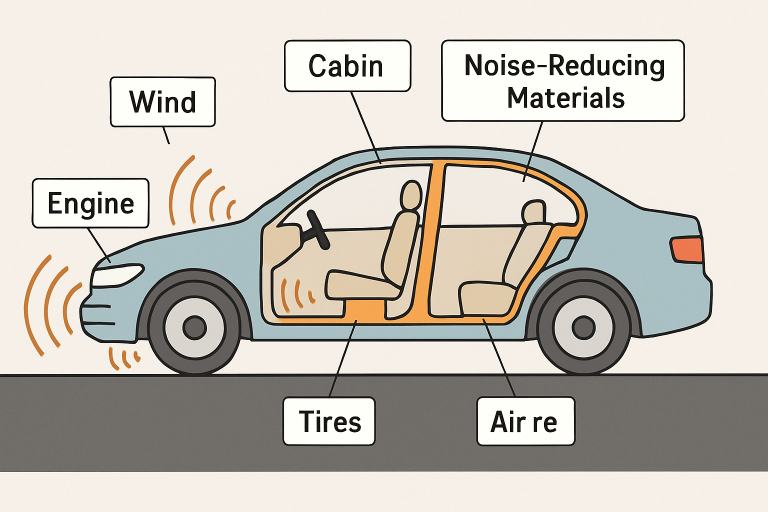
The first step in designing effective noise reduction strategies is to analyze the source of vehicle noise carefully. Road noise commonly stems from three primary sources:
- Tire-Road Contact: The friction and vibration generated when tires roll across the pavement, particularly asphalt or concrete, contribute significantly to external and in-cabin noise. Tread patterns and the type of surface have a profound impact on the volume and frequency of noise created.
- Aerodynamic Forces: As vehicles travel at higher speeds, air turbulence caused by the vehicle’s shape, side mirrors, and windows leads to additional sound waves that enter the cabin. These become more pronounced at highway speeds.
- Mechanical Components: Noise from the engine, transmission, and other moving parts also contributes to the overall soundscape inside and outside the vehicle, particularly in older or poorly insulated models.
Addressing road noise requires isolating each source and applying a targeted solution—whether structural, material-based, or technology-driven. According to the BBC, urban noise pollution is a growing concern, with excessive sound exposure linked to public health challenges, including increased stress and sleep disturbances.
Innovative Materials for Noise Reduction
The use of advanced materials is revolutionizing noise reduction efforts in the automotive industry. Rubberized asphalt, which incorporates recycled tires, not only improves road durability but also reduces traffic noise by up to 12 decibels. This innovation showcases a sustainable approach to highway engineering, while also significantly benefiting nearby communities.
Inside vehicles, materials such as acoustic glass, multi-layer door seals, and specialized sound-absorbing insulation are now commonplace. These advancements trap and dissipate sound waves before they reach the cabin, reducing the need for heavier, less eco-friendly materials.
As automakers develop thinner body panels to make cars lighter and more fuel-efficient, the need for high-performance acoustic materials grows. Notably, foam-based dampers and viscoelastic polymers are effective in managing vibrations and blocking airborne noise.
Active Noise Control Technologies
Beyond passive materials, technological innovations are transforming how vehicles manage sound. Active Noise Control (ANC) uses microphones and speakers to monitor external and internal sounds, emitting phase-inverted sound waves that cancel out unwanted noise. Industry leaders, such as HARMAN, have made significant strides with their Road Noise Cancellation (RNC) systems, which specifically target road-induced vibrations.
With the rise of electric vehicles, where traditional engine noise is absent, such technologies become even more crucial. RNC systems enable manufacturers to utilize lighter body structures without compromising acoustic comfort, providing both a quieter and more environmentally friendly ride.
Additionally, adaptive ANC technologies can respond dynamically to changes in speed, road surface, and vehicle load, fine-tuning the cabin environment in real-time for optimal results.
Impact of Speed on Road Noise
Vehicle speed is directly proportional to the level of road noise produced. Research suggests that reducing driving speeds, particularly in urban environments, can lower both the intensity and reach of traffic noise. For example, following the implementation of a 50 km/h (31 mph) speed limit on Paris’s urban ring road, ambient noise levels decreased by 2.7 decibels, providing measurable relief for both residents and motorists.
Limiting speed not only supports noise reduction but also aligns with broader goals of improved road safety and reduced emissions. Municipalities considering new noise abatement policies often cite speed management as an immediate, cost-effective solution.
Future Trends in Noise Reduction
The integration of innovative materials, real-time acoustic sensors, and software-driven solutions will define the future of noise reduction in modern vehicles. ZF Group’s development of software-based noise reduction, which utilizes the vehicle’s own chassis components to dampen vibrations and sound waves, marks a new era where noise cancellation becomes an integral vehicle function rather than an add-on feature.
We can also expect to see crossover developments from sectors like aerospace, where lightweight materials and noise management are crucial for both comfort and operational efficiency. The transfer of these technologies to the automotive industry is already underway, promising even greater acoustic comfort for drivers in the years to come.
As vehicle electrification and autonomous driving continue to evolve, the continuous enhancement of noise reduction will be at the forefront of automotive engineering. By bridging innovative materials, software, and best practices, the quest for silence on the road is entering a new chapter—benefiting drivers, passengers, and communities worldwide.