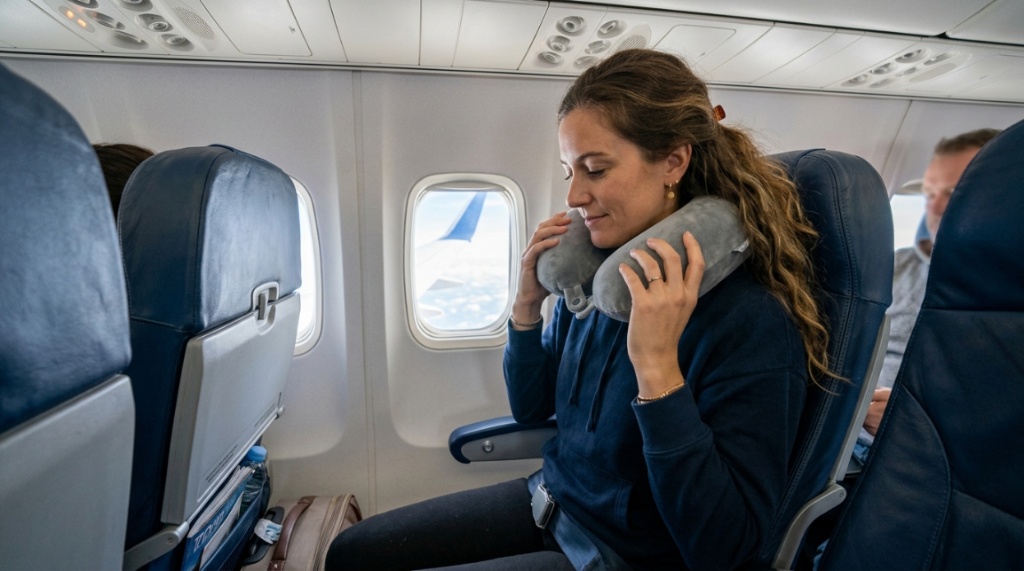
You are exhausted. You have a six-hour red-eye ahead, and the moment you close your eyes, your head drops forward, your neck aches, and you jolt awake. This is the universal struggle of air travel. The promise of arriving refreshed feels impossible when you are fighting your own anatomy in a cramped seat. The solution experts recommend is often a simple piece of foam or memory material. But why do some travelers swear by their neck pillows while others abandon them in hotel trash bins? The answer lies in how you use this tool, not just which one you buy.
To truly master the art of resting at 35,000 feet, you need a strategy that combines the right gear with the right biomechanics. While many cheap options fail, a quality pillow designed with proper cervical support can be a game-changer. Understanding the “why” behind neck pain in flight is the first step. From there, we can explore how to position your body, what features to look for, and the simple hacks that transform a cramped economy seat into a temporary sanctuary.
Why Does Sleeping Upright Hurt Your Neck in the First Place?
When you sleep sitting upright, your muscles relax entirely. Without support, your head, which weighs roughly 10–12 pounds, moves into extreme flexion or lateral bending. This stretches the ligaments and muscles in your neck beyond their comfortable range, leading to stiffness and sharp pain upon waking.
The problem is compounded by the seat design. Most airline seats have a “bucket” shape that tilts your pelvis backward. This forces your lower back to curve, which pushes your head forward into a “text neck” position, even before you fall asleep. A flat pillow behind your head does not solve this; it only prevents your skull from touching the headrest.
Understanding Cervical Lordosis and Airplane Seats
Cervical lordosis is the natural inward curve of your neck. To sleep without pain, you must maintain this curve. A neck pillow works by filling the space between your shoulder and ear, keeping the curve aligned. Without it, your neck collapses into a “C” shape, cutting off blood flow and causing muscle spasms.
Why Your Shoulders Are the Real Culprit
Your shoulders are too wide. In an airplane seat, the headrest is often positioned behind your upper back, but your shoulders push your head forward. A good pillow must sit behind your neck and *slightly* under your ears, not just behind your head, to bridge this gap effectively.
What Type of Neck Pillow Actually Works Best?
U-shaped pillows are the most common, but they are not all created equal. The shape, fill material, and size matter more than the brand. For most people, a U-shaped pillow that wraps to the front and supports the chin is less effective than one that sits primarily at the back and sides.
The “horseshoe” design is popular because it works with the seat. However, a fully closed “O” shape can tilt your head forward. The ideal pillow keeps your head in a neutral, centered position. You want to avoid any design that forces your chin toward your chest.
Memory Foam vs. Microbead vs. Inflatable
| Fill Type | Support Level | Portability | Best For |
|---|---|---|---|
| Memory Foam | High (molds to shape) | Bulky (takes space) | Long-haul, side sleepers |
| Microbead | Low (shifts easily) | Lightweight | Short naps, kids |
| Inflatable | Adjustable | Very compact | Minimalists, backpackers |
Memory foam is generally superior for support because it maintains resistance. Inflatable options are great for space-saving but require precise inflation; too much air makes it hard, too little offers no support.
Why Chin Support Might Be a Gimmick
Many pillows have a “chin strap” or “chin scoop” to prevent the head from dropping forward. While this seems helpful, it often forces the jaw backward, which can restrict breathing. You want a pillow that is tall enough at the sides to catch your cheekbone, not one that constrains your chin, For those who want that same level of deep, restorative rest once you’ve landed, upgrading your nightly routine with the LOFE Buckwheat Pillow Is Perfect for Comfortable Sleep.
How Should You Position a Neck Pillow for Maximum Comfort?
Positioning is 80% of the battle. The pillow should be placed so that it curves around the back of your neck, with the thicker parts of the “U” sitting between your ear and shoulder. It should not be worn like a collar pushed up against your jawline.
The goal is to create a “cradle” effect. You need to lean back slightly, not forward. The headrest should support your occipital bone (the base of your skull), while the pillow supports your cervical spine.
The “Forward Tilt” Trick for Window Seats
If you are by the window, use a small rolled-up jacket or a lumbar pillow. Place it between your thigh and the window wall. Then, turn your body toward the window and use your neck pillow to lean against the wall. This creates a flat, stable surface, mimicking a bed.
The “Recline Lean” for Aisle Seats
In an aisle seat, you cannot lean sideways safely. Instead, recline your seat slightly (if allowed) and place the pillow *behind* your lower back, not your neck. This tilts your pelvis forward, which naturally brings your head into a better alignment with the headrest.
Can You Use a Neck Pillow with a Window or Aisle Seat?
Yes, but the technique changes. A window seat offers a hard surface to lean on. Most travelers fail because they try to use the pillow *and* the window at the same time, creating an uneven pressure point. In an aisle seat, you rely entirely on the pillow and the headrest.
For window seats, the window wall is actually your best friend. Place the pillow so that the back of your head is against the wall, with the pillows’ side flaps folded down to support your jaw. This prevents your head from bobbing forward.
How to Use a Pillow Without a Seat Recline
If you are stuck in a seat that does not recline, use a lumbar support (inflatable) behind your lower back. This pushes your chest forward, allowing your head to rest naturally against the headrest without having to tilt your neck back excessively. The neck pillow then just fills the gap behind your ears.
Why Headrest Wings Matter More Than You Think
Some airline headrests have foldable wings. If yours does, fold them inward to cup your head *before* you put on your neck pillow. This stops your head from rolling side to side. The neck pillow then adds the extra height needed to bridge the gap to your shoulders.
Which Materials Reduce Heat and Sweat on Flights?
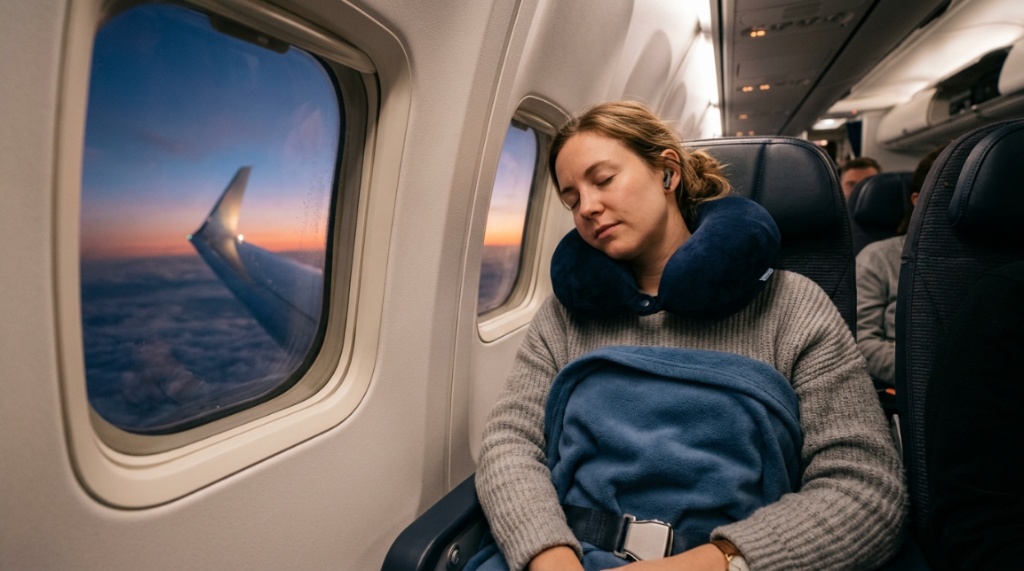
Flights often have fluctuating temperatures. You might be cold at takeoff and hot during the cruise. A pillow that retains heat (like thick polyester) will make you sweaty and restless. Look for breathable covers, such as bamboo or cotton, and open-cell foams.
Memory foam is temperature-sensitive, meaning it becomes softer with heat On a warm plane, it might become too soft to provide support. In contrast, “cooling gel” infused foam or ventilated foam keeps its firmness and wicks away moisture.
The Role of the Cover Fabric
You should avoid velour or fleece covers. These trap heat. A smooth, stretchable jersey or a mesh cover is better. It allows air circulation and prevents friction against your skin.
Is Inflatable Better for Climate Control?
Inflatable pillows are made of plastic or nylon, which can stick to your skin. They also make a crinkly sound. To use them comfortably, cover them with a fabric sleeve. This adds comfort and absorbs sweat.
How to Pack a Neck Pillow Without Wasting Space?
Carrying a bulky memory foam pillow is a nuisance. Many travelers prefer inflatable options for this reason. You can deflate them after landing and stuff them in a backpack. However, if you prefer foam, use a compression sack or clip it to the outside of your carry-on using a carabiner.
You can also stuff a travel pillow inside a jacket sleeve to save luggage space. Do not carry it around your neck through the airport; this strains your neck and makes you look like a tourist.
The “Stuff Sack” Hack for Memory Foam
Purchase a small compression dry bag. Place the pillow inside, roll it to squeeze out the air, and seal it. This reduces its volume by half. When you land, open the bag immediately to let it regain shape.
Ways to Use a Pillow While Not on the Plane
Use your neck pillow as a lumbar support on long bus rides or while reading in bed. You can also fold it in half and use it as a cushion for meditation. This justifies bringing it along even if you only use it once on a flight.
Can a Neck Pillow Help with Deep Vein Thrombosis (DVT) Risk?
While a neck pillow does not directly prevent DVT, it encourages better posture, which allows for more comfortable leg movement. If your neck is supported, you are less likely to slump, which can tense up your hips and restrict blood flow in your legs.
Using a pillow that tilts your pelvis forward (seat cushion) is better for circulation. But a neck pillow that works allows you to relax, which lowers overall muscle tension. You are more likely to do calf raises and stretches if you are not feeling cranky from an aching neck.
Combining Neck Support with Leg Exercises
Set a timer on your phone to perform a simple routine every 30 minutes. With your neck supported, you can focus on foot pumps and shoulder rolls. This keeps blood flowing and prevents stiffness.
Is It Better to Skip the Pillow to Avoid Overheating?
No, just choose a breathable material. Overheating is a common complaint, but it is usually due to low-quality foam. A ventilated gel or a shredded latex pillow offers support and airflow, reducing the risk of sweating.
When Is the Best Time to Use a Neck Pillow During the Flight?
You should not use it during meal service. The tray table blocks your space, and the pillow will get in the way. Use it during the initial climb if you are tired, but the best time is after the seatbelt sign is off and the cabin noise settles.
Using the pillow for a short nap early in the flight is better than waiting until you are exhausted. If you wait too long, you might be too tense to relax properly, even with support.
How to Distinguish Sleep Time from Snack Time
Pull the pillow out when you intend to close your eyes. When the flight attendants come around with drinks, slide it down to your lap. This signals to your body that the nap is over and helps you remain alert to avoid spills.
Signs You Should Stop Using It
If you feel a pinch in your jaw or temple, the pillow is too thick. If you feel a stretch in the back of your neck, it is too thin. Adjust it immediately. Do not “power through” discomfort; it only leads to a worse headache.
How to Clean and Maintain a Travel Neck Pillow?
Travel pillows collect sweat, hair oils, and bacteria. You should clean them after every few trips. The fill type dictates the cleaning method. Do not throw a memory foam pillow in the washing machine; it will destroy the foam.
Use a washable cover. If you cannot remove the cover, spot-clean with a damp cloth and mild soap. For inflatable pillows, wipe them down with disinfectant wipes after every flight.
Step-by-Step Cleaning for Memory Foam
- Remove the cover and wash it in cold water on a gentle cycle.
- Fill a basin with cool water and a drop of gentle detergent.
- Dip a cloth in the mixture and wring it out until damp.
- Dab the foam to remove stains, but do not soak it.
- Rinse the cloth with clean water and wipe away any soap residue.
- Squeeze out excess water (do not twist) and lay flat to air dry for 24 hours.
Why You Should Never Machine Dry a Neck Pillow
The heat of a dryer causes memory foam to crumble and lose its density. It can also melt synthetic materials. Always air dry. To speed up the process, put the pillow in front of a fan.
What Are the Common Mistakes That Ruin Neck Pillow Comfort?
The most common mistake is wearing the pillow backwards. Many people put the clip or tag at the front. You want the opening facing forward (toward your throat) or backward (toward the seat), depending on where you need support. Usually, the thicker part goes to the back.
Another mistake is buying a pillow that is too small. If the sides do not reach your jaw, it will not support your head. On the flip side, a pillow that pushes your head forward will cause a “tech neck” strain.
Why Size and Firmness Matter More than Brand
Ignore the brand and look at the dimensions. Measure the distance from your ear to your shoulder. Your pillow should be slightly thicker than this measurement. If it is thinner, your neck tilts downward; if thicker, your head tilts upward—both cause pain.
The Role of a Lumbar Pillow in Neck Alignment
You cannot fix your neck without fixing your pelvis. If your lower back hurts, your neck will compensate. Use a small cylindrical lumbar cushion to support the curve in your lower back. This aligns your whole spine, making the neck pillow actually effective.
Why Do Some Travelers Prefer No Pillow at All?
Some elite travelers—like pilots and flight attendants—often skip the neck pillow. This is because they lean against the seat using a different method: they slightly tilt their head back to rest on the headrest, not forward. However, this position is rarely sustainable for long periods without causing neck fatigue.
It is true that a poorly designed pillow is worse than none. If you have a thick, convex pillow, it will push your head forward. In this case, using a folded blanket or a rolled-up sweatshirt offers more customized support than a fixed shape.
Comparing Travel Pillows to DIY Alternatives
A rolled-up scarf or a spare jacket placed behind your neck can be adjusted to any height you need. This is often more effective than a rigid U-shaped pillow. However, a quality U-shaped pillow distributes pressure evenly across the shoulder, which a scarf cannot do. The choice comes down to personal anatomy and the ability to keep the DIY item in place.
Is an “X” or “J” Shape Better?
Some newer pillows have an “X” shape to allow side-sleeping against the tray table. However, for upright sitting, a classic U-shape that is filled with cut memory foam pieces (which move) is often easier to adjust. The key is to find it comfortable. If you sleep hot, pick a gel-infused foam. If you sleep cold, pick a down alternative fill.
How to Choose a Neck Pillow for Long-Haul vs. Short-Haul Flights?
For short flights (under 3 hours), you might only need an inflatable pillow. It is compact and provides enough support for a brief snooze. For long-haul flights (over 8 hours), you need a robust memory foam pillow with a washable cover and a shape that prevents “head bobbing.”
On long flights, you will likely cycle through different positions. Your pillow must be flexible enough to change shape or be repositioned multiple times without flattening permanently.
What to Look for in an Ultra-Compact Pillow
If you are using an inflatable pillow, choose one with a micro-adjustable valve. This allows you to let out small amounts of air to get the perfect firmness. Ensure the valve does not stick out, or it might poke your neck.
When to Switch from Pillow to Blanket
If you have a window seat and a blanket, you can wedge the blanket between your shoulder and the window wall. This often works better than a neck pillow because it conforms perfectly to your body. Use your neck pillow for your head and the blanket for your shoulders for a full-body support system.
Frequently Asked Questions
How do I stop my head from falling forward with a neck pillow?
Position the pillow so it is directly behind your neck, not your shoulders. Tilt your head back slightly to engage the pillow. The pillow should press against the base of your skull, not the middle of your neck.
Is an inflatable neck pillow better than memory foam?
Inflatable pillows are better for packing, while memory foam is better for support. If you are a side sleeper, memory foam is superior. If you only need occasional support and value space, choose inflatable.
Can using a neck pillow make my pain worse?
Yes, if it is too thick or too thin. It must match your neck length. A pillow that pushes your head forward will cause muscle strain. Test different sizes and use the one that keeps your ears aligned with your shoulders.
How do I clean a neck pillow stuffed with shredded foam?
Remove the cover and wash it. For the shredded foam, place it in a pillowcase, tie it shut, and air it out. Do not wash the foam directly. If it is odor-prone, sprinkle baking soda, let it sit, and vacuum it off.
Should I use a neck pillow on turbulences?
Yes, but keep your seatbelt on. The pillow provides head support, but during severe turbulence, you should lean forward and brace. Do not try to sleep if the pilot warns of rough air.
Can I use a memory foam pillow as a lumbar support?
Absolutely. If you find your neck pillow is too thick for your neck, place it behind your lower back. This can relieve pressure and help you maintain posture, which in turn helps your neck alignment.
Conclusion
Mastering sleep on a plane is not about buying the most expensive accessory; it is about understanding the geometry of your body and the seat. You need a pillow that supports your cervical curve, a seat position that aligns your hips, and the awareness to adjust when discomfort strikes. This might mean opting for a high-quality inflatable model over a bulky foam one, or it might mean rolling up a hoodie and using a lumbar cushion. The ultimate goal is to arrive at your destination without numbness or a stiff neck. By following the techniques above, you can turn a cramped ride into a restorative break.
Your next flight presents a unique opportunity to refine this skill. Start by experimenting with your current pillow, or invest in one designed with specific cervical support intentions. Do not be afraid to combine it with blankets and window walls. Your body will respond to the proper alignment, and you will finally understand why the right neck pillow is a travel essential. Safe travels, and here’s to a well-rested journey.