You finally set up that freshwater tank, added the substrate, and picked out some beautiful plants. But now you are staring at a wall of LED fixtures online, and everything looks like a confusing mess of lumens, kelvins, and PAR values. The truth is, choosing the wrong light can turn your lush aquascape into a swamp of algae or, worse, leave your plants starving for energy. The good news is that selecting the perfect freshwater aquarium LED lights aquarium lighting guide does not have to be rocket science. This guide will walk you through exactly what to look for, so you can stop guessing and start growing.
What Makes LED Lights Different from Standard Aquarium Lights?
LED lights are the modern standard because they are energy-efficient, long-lasting, and produce very little heat. Unlike fluorescent tubes, which lose intensity over time and require frequent bulb changes, LEDs maintain consistent output for years. They also allow for precise control over color spectrum and brightness, which is critical for plant health and fish coloration.
Older technology like T8 or T5 fluorescent lights often ran hot, wasted electricity, and had limited spectrum control. LEDs solve these issues by using diodes that emit specific wavelengths of light. This means you can target the exact red and blue spectrums that plants need for photosynthesis, while skipping the wavelengths that fuel excessive algae growth. Additionally, LEDs are safer; they run at low voltage and do not contain mercury like CFL bulbs.
Why Is Light Spectrum Important for Freshwater Plants?
The light spectrum determines which colors of light are available for photosynthesis. Plants primarily use red light (around 660nm) and blue light (around 450nm) to drive growth. Blue light promotes compact, leafy growth, while red light encourages flowering and stem elongation.
If you are growing low-light plants like Java Fern or Anubias, a basic white LED will suffice. However, for high-tech planted tanks requiring carpet plants like Hemianthus callitrichoides (HC Cuba), you need a full-spectrum fixture with dedicated red and blue diodes. Many beginner lights are heavy on green and yellow light, which makes the tank look bright to the human eye but is nearly useless for plants. Always check the spectral graph of the light. Look for noticeable peaks in the red and blue ranges. Avoid lights that claim to be “plant lights” but only have a blueish tint; they will promote algae but starve your plants.
Which Light Intensity (PAR) Do You Need for Your Tank?
PAR (Photosynthetically Active Radiation) measures the amount of usable light that reaches your plants. For a standard, low-tech tank with no CO2 injection, you need a PAR of 20-40 µmol/m²/s at the substrate. For a high-tech tank with CO2, aim for 50-80 µmol/m²/s or higher.
The depth of your tank is the biggest factor here. Water absorbs light very quickly, especially red light. A standard 20-gallon tall tank (24 inches deep) needs a much more powerful fixture than a shallow 10-gallon tank. Here is a simple breakdown:
| Lighting Level | PAR Range (at substrate) | Ideal For | Example Plants |
|---|---|---|---|
| Low | 15–30 µmol/m²/s | No CO2, low-tech tanks | Java Fern, Anubias, Cryptocorynes |
| Medium | 30–60 µmol/m²/s | Some CO2, moderate growth | Amazon Sword, Vallisneria, Java Moss |
| High | 60–100+ µmol/m²/s | Pressurized CO2, high-tech | HC Cuba, Monte Carlo, Rotala |
Pro tip: If you buy a light that is too powerful, you can always dim it. If you buy a weak light, you cannot make it stronger. It is often better to overshoot slightly and use the dimmer than to end up with a dark, dying tank.
How Do You Calculate the Right Wattage for Your Aquarium?
The old rule of thumb (2–5 watts per gallon for fluorescent lights) does not apply to LEDs because they are much more efficient. Instead, focus on the fixture’s power draw and the tank depth. For a typical freshwater setup, look for a fixture that draws approximately 0.5 to 1 watt per gallon of actual power, not “equivalent” wattage.
For example, a 24-inch light pulling 30 watts is usually sufficient for a 20-gallon long tank (12 inches deep) running medium light. However, a standard 20-gallon tall tank (24 inches deep) will need closer to 40-50 watts because the light has to penetrate further. A better method is to look for the fixture’s diameter and the number of LEDs. A bar light with 48 LEDs will typically be stronger than one with 24 LEDs, even if they are the same length. If you are unsure, the freshwater aquarium LED lights aquarium lighting guide includes specific wattage recommendations for common tank sizes to help you match the hardware to your needs.
Can You Use a Timer or Controller with Your LED Lights?
Yes, and you absolutely should. Consistent light cycles are crucial for fish health and algae control. Most modern LED fixtures come with built-in timers or are compatible with smart plugs. A standard photo period of 7–8 hours is ideal for most planted tanks.
Running lights for longer than 9 hours almost always leads to algae blooms, especially green spot algae and hair algae. Controllers add another layer of control. With a programmable controller, you can simulate sunrise and sunset, slowly ramping the light intensity up and down. This prevents fish from being startled and reduces algae triggers. Some advanced controllers even allow you to set specific color channels (RGB) to create a custom look throughout the day. If you have a high-tech tank with CO2, a controller is almost mandatory because you need to synchronize the light cycle with your CO2 injection schedule for maximum efficiency.
How Does Tank Depth Affect Your Lighting Choice?
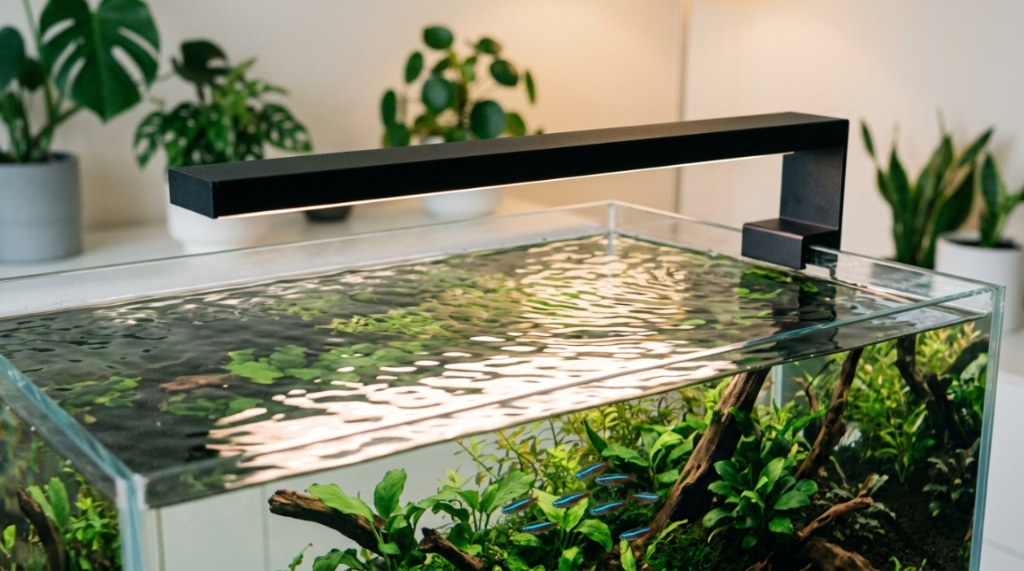
Tank depth is the single most important physical factor in lighting selection. Water absorbs light rapidly; for every 10 inches of water depth, you lose roughly 50% of the light intensity. A light that works perfectly on a 12-inch deep tank will be useless on a 24-inch deep tank.
For shallow tanks (under 16 inches deep), a standard bar light or even a clip-on light is sufficient. For medium depth tanks (16-22 inches), you need a light with a higher PAR rating (at least 40+ at the bottom) and possibly a reflector to focus the light downward. For deep tanks (over 24 inches), you need a powerful panel light or two bar lights running side-by-side. Deep tanks also benefit from lights with higher Kelvin ratings (6500K–7500K) because blue light penetrates water better than red light. If you have a deep tank, skip the “planted” LEDs and look specifically for high-output fixtures designed for reef tanks that have been tuned for freshwater spectrum.
Which Color Temperature (Kelvin) Is Best for Freshwater?
The ideal color temperature for freshwater aquariums is between 6500K and 7500K. This range mimics the natural midday sun and promotes the best balance of plant growth and visual appeal. Lights with a lower Kelvin (3000K–4500K) look warm and yellowish, which can make plants look dull. Lights above 10000K look blueish and are better suited for marine tanks where you want to see fluorescence.
Why 6500K? This is the color temperature of direct sunlight at noon. Plants evolved to photosynthesize most efficiently under this light. A 6500K light will make your green plants look vibrant and natural. It also provides a good balance of red and blue spectrum. Some fixtures offer adjustable RGB (Red, Green, Blue) channels, allowing you to dial in a custom color temperature. You can set it to 6500K for daily viewing and then switch to a warmer or cooler setting for evening viewing. Avoid “cool white” LEDs from hardware stores; they are usually around 4000K–5000K and lack the red spectrum needed for healthy plant growth.
How Do You Prevent Algae When Using Strong LED Lights?
Algae outbreaks happen when there is an imbalance between light, nutrients, and CO2. Strong LED lights accelerate growth, but if your plants cannot use all that energy, algae will thrive. The keys to prevention are a consistent photo period, nutrient control, and carbon availability.
- Start with a shorter photo period. When you install new lights, run them for only 5 hours a day for the first two weeks. Increase by 30 minutes each week until you reach 7–8 hours.
- Use a dimmer. If your light has adjustable intensity, start at 50% power and ramp up slowly as the plants establish roots.
- Add fast-growing plants. Floaters like Salvinia or stem plants like Hygrophila polysperma will outcompete algae for nutrients.
- Balance CO2. If you have high light, you must have adequate CO2 (either injected or from a liquid carbon source like Excel). Without CO2, plants cannot process the light, and algae will take over.
- Do not overshoot the photo period. 8 hours is the maximum for most setups. Adding more light hours does not grow plants faster; it grows algae faster.
What Features Should You Look for in a Budget LED Light?
You do not need to spend hundreds of dollars to get a good light. Some budget fixtures offer excellent performance for low-tech tanks. The key features to prioritize are a full spectrum (6500K), sufficient wattage for your tank depth, and a built-in timer or ramping function.
A good budget light will have at least 0.5 watts per gallon of actual power. It should also have a sturdy mounting system that keeps the light off the water surface to avoid moisture damage. Avoid lights that only use blue and red LEDs without white LEDs; they will make your tank look like a disco club. Look for a “daylight” or “plant” mode that combines multiple diodes. Many budget lights now include a remote control or smartphone app for adjusting brightness and color, which is a huge bonus. Remember, a cheap light that runs correctly for two years is often better than an expensive light that fails after six months. Read reviews about build quality, not just performance numbers.
Are DIY LED Light Kits a Viable Option?
Yes, DIY LED kits can be a viable option if you are handy with a soldering iron and understand basic electronics. They often allow you to customize the spectrum and brightness to a degree that commercial fixtures cannot match. However, they come with several risks.
Pros of DIY Kits
- Customization: You can choose specific Crees or Philips LEDs for peak performance.
- Cost: A DIY kit can be cheaper than a high-end commercial light.
- Learning experience: You will understand exactly how your light works.
Cons of DIY Kits
- Water damage risk: Without proper sealing, one splash can short the system.
- No warranty: If you burn a diode, you are on your own.
- Time commitment: It takes several hours to assemble and test.
- Aesthetics: DIY builds often look messy and may not fit over the tank nicely.
For most hobbyists, a pre-assembled fixture from a reputable brand is safer and more practical. Only go DIY if you have experience with electronics and want absolute control over the spectrum.
How to Match Your Light to Your Tank’s Planted Goals
The lighting you choose must match your long-term goals for the tank. If you only want a few low-light plants and a community of fish, you do not need a $400 light fixture. Conversely, if you plan to grow a dense Dutch-style aquascape, you must invest in high-output equipment.
- Low-Tech Natural Setup: Choose a single bar light with 20-30 PAR at the substrate. Focus on 6500K color temperature. Plants: Anubias, Java Fern, Cryptocorynes, Moss.
- Medium-Tech Community Tank: Use a double bar or a panel light with 40-60 PAR. Look for RGB control for color enhancement. Plants: Amazon Swords, Vallisneria, Rotala, Ludwigia.
- High-Tech Aquascape: Invest in a high-end fixture with adjustable intensity and spectrum. You need 60+ PAR and a programmable controller. Plants: HC Cuba, Monte Carlo, Glossostigma, Blyxa, and red stem plants.
Always consider your budget for CO2 and fertilizer as well. A light that produces 80 PAR is useless if you cannot also afford a CO2 system and quality fertilizers. The light is just one part of a triangle that also includes nutrients and carbon.
While setting up your new lighting system, you might also want to secure your hardscape. Check out our comprehensive guide on choosing the best Aquarium Glue for Aquascaping Projects to keep your rocks and driftwood perfectly in place.
Conclusion
Choosing the right LED light for your freshwater tank does not need to be overwhelming. Start by measuring the depth of your tank and determining what you want to grow. If you stick to low-light plants, almost any 6500K LED bar light will work. If you dream of a lush, green carpet, you need to calculate the PAR requirements and invest in a fixture with adjustable intensity. Remember to keep your photo period under 8 hours and always balance light with CO2 and nutrients to keep algae at bay. Take your time, read the specifications carefully, and do not be afraid to buy a slightly more powerful light than you think you need—you can always dim it. Your plants will reward you with vibrant, healthy growth.
Frequently Asked Questions
Can I use a plant light meant for houseplants on my aquarium?
It is not recommended. Houseplant LEDs are not sealed against moisture and can fail quickly due to humidity. Furthermore, they often lack the specific red and blue spectrums needed for aquatic plant photosynthesis.
How often should I replace aquarium LED lights?
High-quality LEDs will last 5-7 years before they degrade to 70% of their original output. However, you should replace them if you notice a significant drop in plant growth or if the color temperature has shifted noticeably (looks too yellow or too blue).
Is blue light at night bad for fish?
Yes, constant blue light (or any light) at night can stress fish and disrupt their sleep cycles. If you have a moonlight feature, use it for only 1-2 hours as a transition to full darkness. Fish need a period of complete darkness to rest and recover.
Do I need a light with a controller if I am a beginner?
No, a controller is a luxury, not a necessity. A basic timer is the most important device. A simple on/off timer provides 95% of the benefit for plant growth and algae control. You can always upgrade to a controller later.
Why is my light causing so much algae?
This is almost always due to too much light intensity, a photo period that is too long, or an imbalance in nutrients and CO2. Reduce your light intensity by 50%, cut the photo period to 6 hours, and add some fast-growing floating plants to see immediate improvement.
How do I clean the LED fixture?
Unplug the light first. Use a soft, slightly damp microfiber cloth to wipe the LEDs and the casing. Do not use any chemicals or abrasive cleaners. Clean salt creep or mineral deposits every two weeks to maintain light output.
Focus Keyphrase: freshwater aquarium LED lights aquarium lighting guide
Meta Description: