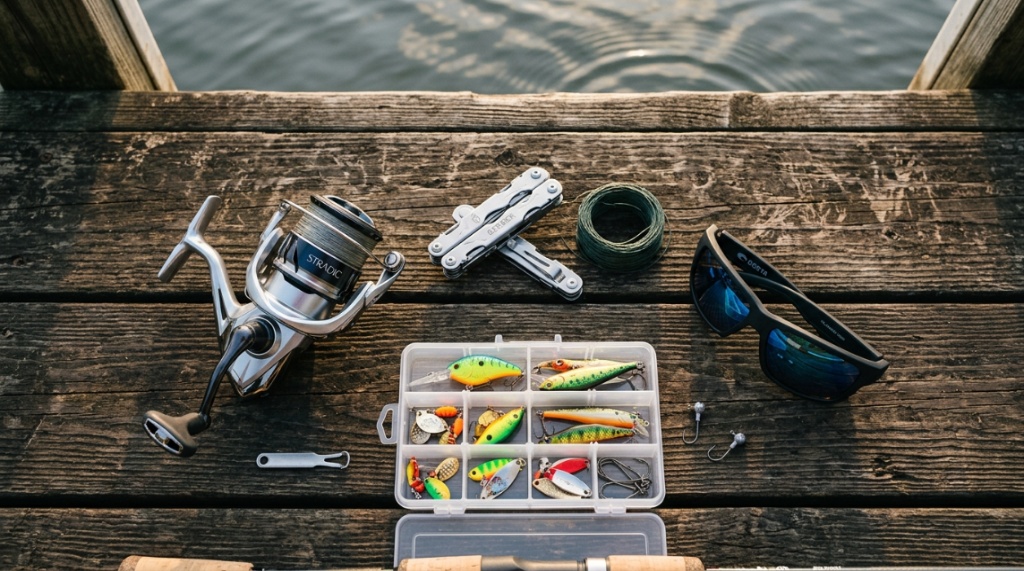
You’ve stared at the tackle shop wall for thirty minutes, overwhelmed by thousands of shiny trinkets that promise to land the fish of a lifetime. You pick up a new lure, a gadget, and a tool—only to get skunked again. The cycle is frustrating, expensive, and confusing. The real problem isn’t a lack of options; it’s the lack of a strategy for choosing fishing accessories fishing gear that actually improve your odds. This guide cuts through the noise, giving you a repeatable system to select only the gear that moves the needle on your success.
What Defines a Fishing Accessory vs. Essential Gear?
An accessory is any non-primary item that enhances your efficiency, safety, or comfort while fishing, whereas essential gear refers to your rod, reel, line, and basic tackle that are mandatory to fish. Accessories make you more effective, but they are useless without the core setup.
Think of it like cooking. Your rod and reel are the stove and pan—you cannot cook without them. Accessories are your knives, measuring cups, and timers. You can cook without them, but your results will be inconsistent and frustrating. Accessories solve specific problems: losing fish at the net, tangled lines, scratched rod guides, or losing tackle in the dark. Every accessory you buy should directly fix a pain point you have experienced on the water.
Why Do Most Anglers Buy the Wrong Accessories?
Most anglers buy the wrong accessories because they purchase based on emotion rather than a documented need. Advertisements and flashy packaging trigger impulse buys that rarely solve real fishing problems.
Consider the “miracle” knot-tying tool you bought last year. Did it actually save you time? Probably not. The best approach is to keep a simple log. After three fishing trips, write down what annoyed you: tangled leaders, lost pliers, or a snapped net handle. Then, buy the accessory that specifically solves that annoyance. This turns your shopping from gambling into an investment.
The “One-Trip” Test
Before buying an accessory, ask yourself: “Will I use this on every single trip for the next month?” If the answer is no, skip it. High-frequency use is the benchmark of a valuable accessory. A digital scale you use once a season is less valuable than a quality pair of split-ring pliers you use every trip.
Which Fishing Accessories Provide the Highest Return on Investment?
The accessories with the highest return on investment are those that prevent lost fish, save time, and protect your primary gear. Top performers include a quality landing net, braid scissors, hemostats, and a tackle bag with organization.
Here is a breakdown of accessories that genuinely pay for themselves:
- Landing Net: A rubber-mesh net prevents removing the protective slime coat from fish, increasing survival rates. It also prevents hook tangles. Cost: $20–$50. Value: Prevents losing trophy fish at the boat.
- Split-Ring Pliers: Cheap pliers bend and rust. A quality pair with tungsten cutters makes changing lures a 10-second job instead of a frustrating minute. Cost: $15–$30. Value: Saves hours of frustration over a season.
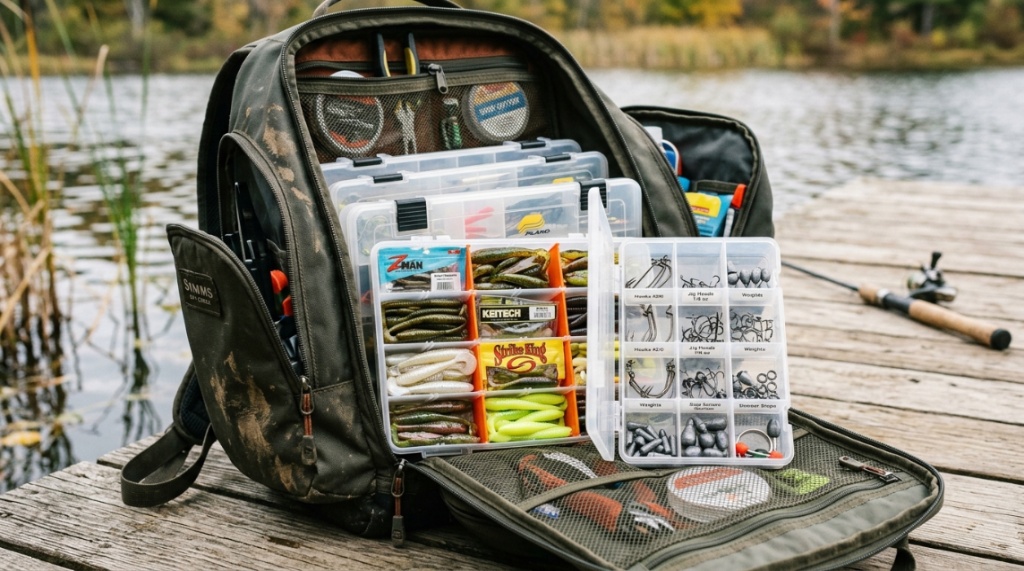
- Tackle Backpack: A hands-free bag with waterproof pockets keeps your hands free for rods and your gear dry. Cost: $40–$80. Value: Prevents the “lost lure” tax and keeps essentials accessible.
- Polarized Sunglasses: They cut glare, allowing you to see structure and fish underwater. They also protect your eyes from a flying treble hook. Cost: $20–$100. Value: Safety and increased catch rates.
How Do You Match Accessories to Your Fishing Style?
Match accessories to your fishing style by identifying the unique demands of your target species and environment. A bass angler needs different tools than a surf fisherman or a fly angler.
For example, if you fish heavy cover for bass, your priority accessories should include a hook sharpener, heavy-duty swivels, and a braid cutter. If you fish open water for trout, your accessories should focus on light leaders, small split shot, and delicate netting. If you fish from a kayak, you need waterproof storage and a leash system for every tool. Buying accessories designed for a different discipline creates frustration.
Environment-Specific Checklist
- Freshwater Bass: Hook sharpener, tungsten weights, worm threader, lip grip.
- Saltwater Surf: Sand spike rod holder, large cooler, long-nose pliers, sunscreen.
- Ice Fishing: Ice skimmer, tip-up lights, hand warmers, tackle sled.
- Fly Fishing: Nippers, tippet rings, floatant, net with catch-and-release rubber mesh.
Can Cheap Fishing Accessories Be Any Good?
Cheap fishing accessories can be good, but only for items with low mechanical complexity. Items like bobbers, split shot, and soft plastic worms perform fine when inexpensive. However, cheap versions of tools with moving parts—pliers, reels, nets—often fail at critical moments.
The key is to consider the “cost per use.” A $5 pair of pliers that breaks after three trips costs $1.66 per use. A $30 pair that lasts 200 trips costs $0.15 per use. The cheap option is more expensive in the long run. For low-tech items like floats or swivels, generic brands are perfectly acceptable. For high-stress items like landing nets or line cutters, invest in quality.
When Should You Upgrade Your Fishing Accessories?
You should upgrade your fishing accessories immediately when an item causes you to lose a fish, wastes time, or creates safety hazard. Waiting until a tool breaks completely is a mistake.
Signs it is time to upgrade:
- Corrosion: Rusty pliers or scissors that won’t cut cleanly. This damages your line and knot strength.
- Poor Fit: A net that is too small for the fish you target, leading to lost catches.
- Frayed Line: A rod guide with a chip that frays your line. Fix or replace instantly.
- Lack of Organization: A tackle box that forces you to dig for ten minutes to find a specific lure.
Pro tip: Upgrade your tackle storage solution before buying new lures. You cannot use what you cannot find. A well-organized system often pays for itself by preventing duplicate purchases of lost tackle.
What Are the Most Overrated Fishing Accessories to Avoid?
The most overrated fishing accessories include electronic line winders, fish finders for casual shore anglers, complex knot-tying tools, and novelty “scent” dispenser gadgets. These items add complexity without solving a core problem.
Here is a comparison of overrated vs. underrated accessories:
| Overrated Accessory | Why It Fails | Better Alternative |
|---|---|---|
| Electronic line winder | Slower than hand-winding; prone to tangles | Simple spooling station or a friend’s help |
| Bait scent spray | Washes off quickly; rarely outperforms fresh bait | Quality live bait or natural scent attractants |
| Complex knot-tying tool | Bulky; easy to lose; slower than learning two knots | Practice the Palomar and Clinch knots |
| Fish finder (casual use) | Requires learning curve; heavy battery; seldom used correctly | Polarized sunglasses to read water |
How Do You Organize Fishing Accessories for Maximum Efficiency?
Organize fishing accessories for maximum efficiency by using a modular system that separates tools, terminal tackle, and soft plastics into dedicated, waterproof compartments. Every item should have a specific home.
Step-by-step organization system:
- Categorize by function: Tools (pliers, scissors, hook sharpener), terminal tackle (hooks, swivels, weights), and soft plastics.
- Use waterproof bags: Invest in a backpack with a waterproof liner or a tackle bag with sealed trays. Moisture is the enemy of sharp hooks and rust-free tools.
- Limit redundancy: Do not carry three sets of pliers. Carry one quality set and know where it is.
- Keep a “day box”: Before each trip, transfer only the lures and accessories you plan to use. This reduces clutter and decision fatigue on the water.
A well-organized system allows you to change a lure in under 30 seconds. This efficiency translates directly into more fishing time and less frustration.
Which Accessories Are Essential for Catch and Release Fishing?
Essential accessories for catch and release fishing include barbless hooks, a rubber-mesh landing net, long-nose pliers, and a hook removal tool. These minimize handling time and injury to the fish.
The fishing accessories fishing gear you choose directly impacts fish survival. Barbless hooks reduce mouth damage and make removal faster. A rubber net removes the slime coat less than nylon mesh. Always wet your hands before touching a fish. Keep pliers handy to remove deep hooks quickly. A simple jaw spreader can also help if you fish with treble hooks. Prioritize tools that allow you to release a fish in under 30 seconds.
Quick-Release Gear Checklist
- Hemostats: For small hooks and precision removal.
- Hook cutters: For deeply ingested hooks; cut the line and leave the hook.
- Lip grip: For larger species like pike or musky, to control the fish without injury.
- Measuring board: To quickly measure and release without excessive handling.
How Do You Test the Quality of a Fishing Accessory Before Buying?
Test the quality of a fishing accessory before buying by checking three things: material composition, hinge or moving part smoothness, and warranty. A quick physical inspection tells you 90% of what you need to know.
Here is how to evaluate common accessories:
- Pliers: Open and close them 20 times. Do they catch? Are the cutting edges sharp? Do the handles feel solid? Cheap pliers feel hollow.
- Nets: Pull on the mesh. Does it stretch easily? Cheap netting frays quickly. Check the handle connection—is it riveted or just glued?
- Tackle boxes: Open and close the latches 10 times. Do they feel brittle? Cheap plastic cracks in cold weather.
- Swivels: Hold the swivel and spin it. Does it rotate freely? If there is any grinding, it will fail under load.
Always buy from a retailer with a return policy. A manufacturer warranty is a sign of confidence. Brands that stand behind their products are almost always higher quality.
Should You Buy Accessory Kits or Individual Items?
You should buy individual items rather than kits because kits include many low-quality, unnecessary pieces that you will never use. Kits are often a way to offload cheap inventory.
Compare the economics: A $30 “starter kit” might include 50 items—20 swivels, 10 snaps, 10 weights, and 10 hooks. But you likely only need 5 high-quality swivels and 3 high-quality snaps. The rest will rust or break. Buy exactly what you need in bulk at a higher quality. For example, purchase a pack of 20 premium swivels for $8 instead of a 50-piece mix for $30. The kit seems cheaper but forces you to carry junk.
How Often Should You Replace Fishing Accessories?
Replace fishing accessories based on wear, not time. Hooks should be replaced when they feel dull against your fingernail. Line should be replaced annually or when nicked. Nets should be replaced when the mesh tears or the handle cracks.
General replacement guidelines:
- Split rings and snaps: Replace before every major trip. They weaken over time and can pop open on a big fish.
- Swivels: Replace if they do not spin freely.
- Tools (pliers, scissors): Replace when cutting edges become dull or when rust appears on the hinge.
- Tackle storage: Replace when latches break or when boxes crack, as they allow moisture in.
Inspect your gear after every trip during cleanup. Five minutes of inspection can prevent a failure that costs you a trophy fish.
Frequently Asked Questions
What is the single most important fishing accessory?
The single most important fishing accessory is a quality pair of polarized sunglasses. They protect your eyes, reduce glare, and allow you to see fish and structure. No other accessory provides this combination of safety and utility.
Can I use a regular backpack for fishing?
Yes, but it is not ideal. Regular backpacks lack waterproof compartments and dedicated rod holders. They also lack organization for small tackle. A dedicated fishing backpack is a worthwhile investment for anyone fishing more than twice a month.
How do I keep my fishing accessories from rusting?
Rinse all metal accessories with freshwater after every trip, especially after saltwater use. Pat them dry immediately. Store them in a dry, ventilated area. Apply a light coat of lubricant to pliers and reels annually.
Do I need a fish finder for bank fishing?
No, a fish finder is generally unnecessary for bank fishing. The battery weight and setup complexity outweigh the benefits for casual shore anglers. Learn to read water structure, shade, and surface activity instead.
Are expensive fishing pliers worth it?
Yes, for regular anglers. Expensive pliers use better steel and bonding at the hinge, lasting many seasons. Cheap pliers corrode quickly and fail at the hinge. If you fish more than ten times a year, invest $30 in a quality pair.
What is the best way to store soft plastic lures?
Store soft plastic lures in their original bags or in sealed plastic containers with ventilation holes. Do not mix different brands in the same container, as they can chemically react and melt together. Keep them out of direct sunlight.
When streamlining your gear, it’s easy to get distracted by flashy gadgets that just add weight to your tackle box. Instead, focus your budget on the foundational equipment that directly impacts your presentation. Along with high-quality line and terminal tackle, pairing your setup with the Best Fishing Reel for Smooth Casting This Year will do more for your success than a dozen gimmicky lures ever could.
Conclusion
Choosing fishing accessories that really matter comes down to one principle: buy for specific problems, not for flashy promises. now know that a quality net, polarized sunglasses, and well-organized storage give you the highest return. know to avoid kits and impulse purchases. have a system to evaluate quality before buying and to replace gear based on wear. Stop wasting money on tools that sit at the bottom of your bag. Start every trip with a clear plan for what accessories you need. Apply the “one-trip test” to everything you consider buying. Your fishing time is limited—make every second count with gear that works as hard as you do.