You waste time every week searching for things you already own. Seasonal clothes. Office files. Tools. Cables. The problem is not storage space. It’s unclear labeling.
According to a 2023 home organization survey by the National Association of Productivity and Organizing Professionals (NAPO), people spend up to 55 minutes per day looking for misplaced items. That equals more than 330 hours per year. Poor labeling is one of the top reasons.
This guide shows you exactly how to label storage boxes for maximum efficiency using proven storage box labeling tips. You’ll learn systems that work in homes, offices, warehouses, and small businesses. No guesswork. No complicated tools. Just practical steps that save time and reduce clutter.
If you want faster access, better inventory control, and less stress, this guide will help you build a labeling system that lasts.
Why Do Most Storage Labeling Systems Fail?
Most storage labeling systems fail because they are inconsistent, unclear, or not visible from multiple angles.
Here’s the real issue.
The Problem
- Boxes are labeled on only one side.
- Handwriting fades or becomes unreadable.
- Labels are too vague (e.g., “Miscellaneous”).
- No category structure exists.
- No master inventory list.
This creates friction. You open multiple boxes to find one item. You repack things incorrectly. Over time, the system collapses.
The Agitation
Imagine searching through 20 similar-looking storage bins during a move. Or trying to locate tax documents under pressure. The cost is not just time. It’s frustration.
The Solution
A structured labeling system using clear naming conventions, durable labels, and category-based organization prevents this chaos.
Let’s break down how to build one.
How Should You Categorize Storage Boxes for Maximum Efficiency?
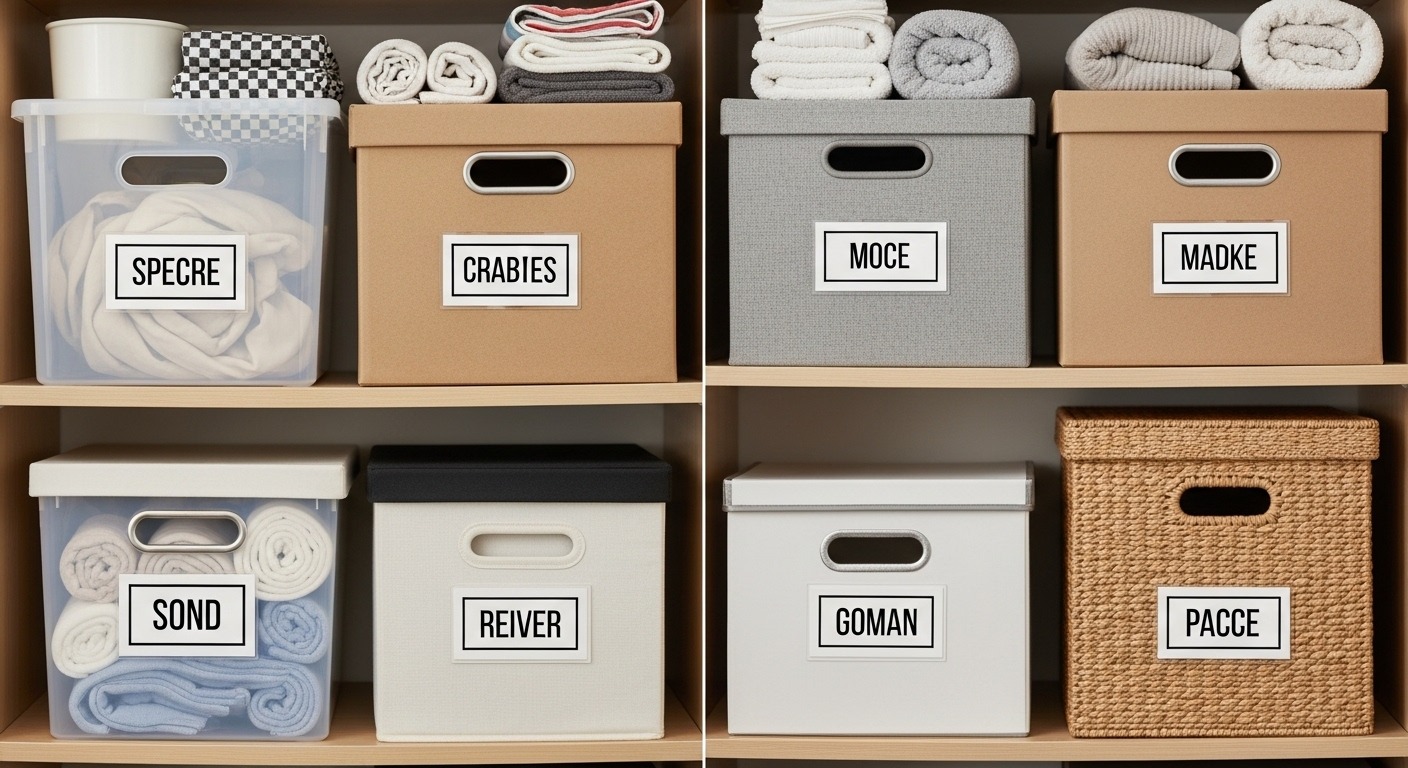
Start by grouping items into broad categories, then subcategories, and assign each storage box a clear category code.
This is the foundation of effective storage organization.
Step 1: Define Primary Categories
- Seasonal Clothing
- Office Documents
- Kitchen Supplies
- Tools and Hardware
- Electronics and Cables
- Kids’ Items
Step 2: Add Subcategories
Example:
- Clothing → Winter Wear → Jackets
- Documents → Finance → Tax Records 2024
Step 3: Assign Category Codes
Example labeling format:
- CL-WIN-01 (Clothing – Winter – Box 1)
- DOC-TAX-24-02
This method is widely used in warehouse labeling systems and inventory management practices. It reduces ambiguity.
Quick Tip: Avoid generic labels like “Old Stuff” or “Random Items.” Specificity improves retrieval speed.
What Is the Best Way to Physically Label Storage Boxes?
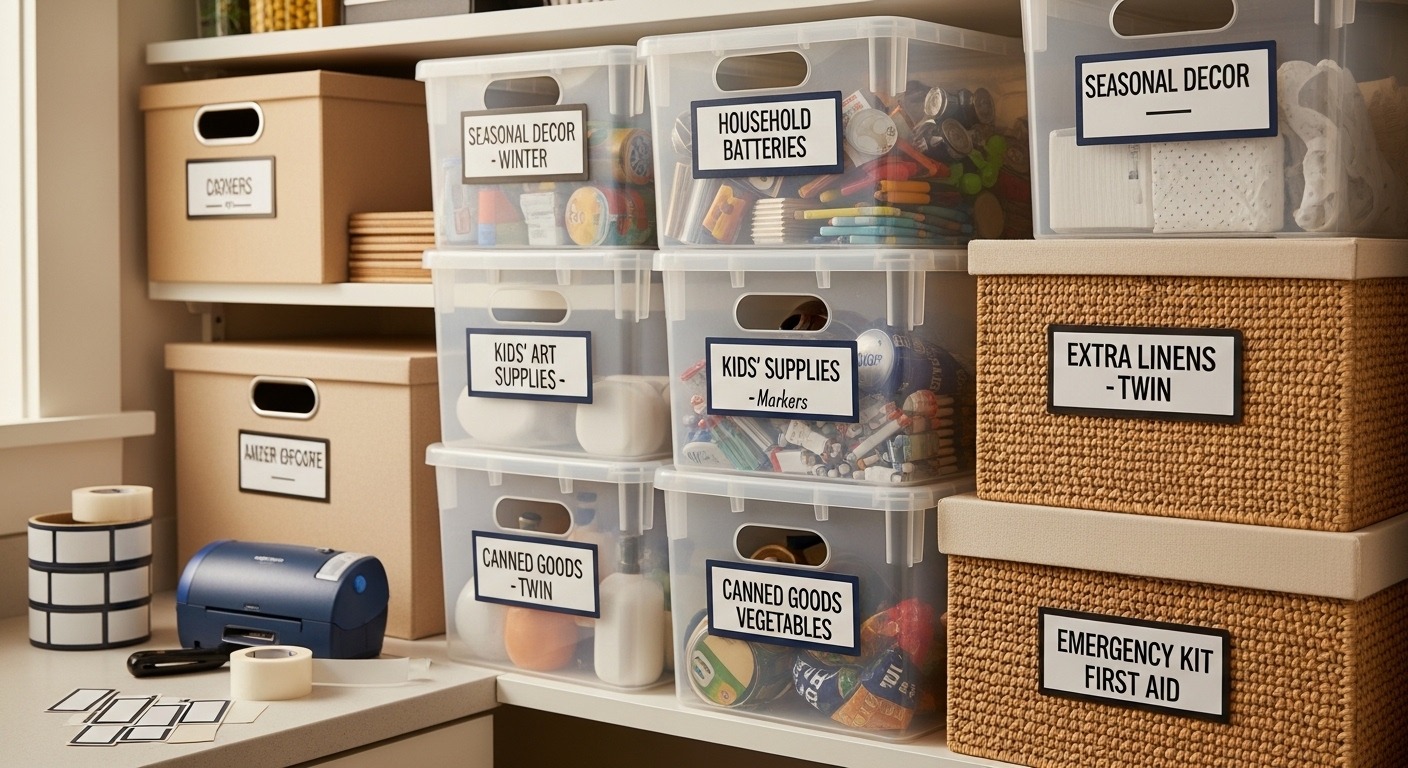
Place durable labels on at least two visible sides of each storage box using waterproof adhesive labels or printed label stickers.
Visibility and durability matter.
Best Practices for Physical Labeling
- Label front and top sides.
- Use large, readable fonts (minimum 18–24 pt).
- Choose waterproof, smudge-resistant materials.
- Avoid permanent marker directly on the box if contents may change.
If you use clear plastic storage bins, insert printed labels inside the sleeve or attach labels inside facing outward. This protects them from peeling.
Handwritten vs Printed Labels
| Method | Pros | Cons |
|---|---|---|
| Handwritten | Fast, low cost | Less durable, inconsistent appearance |
| Printed Labels | Professional, clear, uniform | Requires printer or label maker |
For long-term storage solutions, printed labels outperform handwritten ones in clarity and lifespan.
Should You Use Color Coding for Storage Box Labeling?
Yes. Color coding improves visual identification and speeds up sorting by category.
Color-coded storage bins are common in warehouses and supply chain systems. The same logic works at home.
Example Color System
- Blue → Documents
- Green → Kitchen
- Red → Tools
- Yellow → Seasonal Items
You can use colored labels, stickers, or colored storage boxes.
Research in visual cognition shows color recognition is processed faster than text. That means less scanning time.
Combine color + text + code for maximum clarity.
How Do You Create an Inventory List for Labeled Storage Boxes?
Create a digital or printed master inventory sheet listing each box code and its detailed contents.
This step transforms simple labeling into a complete storage management system.
Basic Inventory Structure
| Box Code | Category | Detailed Contents | Location |
|---|---|---|---|
| DOC-TAX-24-01 | Finance | Income tax forms, receipts, audit papers | Garage Shelf A |
You can create this in:
- Google Sheets
- Excel
- Notion
- Printed binder
Case Study Insight: A small eCommerce business reduced item retrieval time by 38% after implementing box codes and a shared digital inventory sheet across its team. Before labeling, employees opened multiple boxes daily. After the system, retrieval became structured and measurable.
Data drives efficiency.
What Are the Best Storage Box Labeling Tips for Small Spaces?
Use vertical stacking labels, clear bins, and standardized naming to maximize visibility in tight areas.
Small apartments and home offices demand smarter storage.
Practical Tips
- Use uniform box sizes for stacking.
- Label top edges for upward visibility.
- Avoid long descriptions; use short codes + inventory list.
- Keep frequently accessed items at eye level.
Space optimization and labeling go together. Without labeling, vertical storage becomes inaccessible storage.
How Often Should You Update Storage Box Labels?
Review and update labels every 6–12 months or whenever contents change significantly.
Static labels create confusion if contents evolve.
Maintenance Checklist
- Check for faded labels.
- Remove outdated category names.
- Update inventory sheet.
- Relabel boxes with changed contents.
Routine review keeps your storage system reliable. Consistency builds long-term efficiency.
What Tools Do You Need for Effective Storage Box Labeling?
Basic tools include adhesive labels, a label maker or printer, permanent marker, and a digital inventory tracker.
Recommended Tools
- Thermal label printer
- Waterproof label stickers
- Clear plastic storage bins
- QR code labels (optional for advanced tracking)
For advanced setups, QR code labeling connects each box to a digital document. Scanning the code reveals contents instantly.
This method is widely used in logistics and warehouse inventory systems.
How Can You Label Storage Boxes for Moving?
Label by destination room, priority level, and fragile status.
Moving creates temporary chaos. Strategic labeling prevents unpacking delays.
Moving Label Format Example
- Room: Kitchen
- Priority: Open First
- Fragile: Yes
- Box #: K-01
Add arrows for orientation if necessary.
Professional moving companies follow this structured labeling system to minimize misplaced boxes.
Conclusion: Ready to Build a Storage Labeling System That Works?
Clutter is not caused by lack of storage. It is caused by lack of structure.
Effective storage box labeling tips focus on three principles: clarity, consistency, and visibility. When you categorize correctly, use durable labels, apply color coding, and maintain an inventory list, you eliminate guesswork.
The result is measurable. Faster retrieval. Less stress. Better space utilization.
Start today. Pick one room. Create category codes. Print clear labels. Build your inventory sheet. Within a few hours, you’ll see the difference.
Take action now. Implement these storage box labeling tips and transform your storage into an organized system that saves time every single day.
Frequently Asked Questions (FAQs)
1. What is the most efficient way to label storage boxes?
The most efficient method is using category codes combined with clear printed labels placed on two visible sides. Pair this with a digital inventory list for detailed tracking.
2. Are label makers better than handwritten labels?
Yes. Label makers provide consistent, durable, and readable text. Handwritten labels may fade or vary in clarity.
3. How do I label storage bins in a garage?
Use waterproof labels, large fonts, and color coding. Place labels on both front and top sides for stacked visibility.
4. Should I label the inside of storage boxes?
You can include a detailed contents sheet inside the box, but external labeling is essential for quick identification.
5. How do businesses manage storage box labeling?
Businesses use coded systems, barcode or QR labeling, and centralized inventory tracking software to manage storage efficiently.
6. How can I label storage boxes for seasonal items?
Create a seasonal category (e.g., SEAS-WIN-01) and store all winter or holiday items under that code. Update annually.